

If you own or manage a healthcare clinic, you’ve probably asked yourself this question:
What produces the best return: Organic or paid marketing?
Today I'm going to break down a marketing framework that will help you predictably fill your clinic with patients—month after month.
When you get this right, you’ll stop scrambling to book your calendar every month. You’ll bring in a steady stream of qualified leads and you can finally focus on helping people.
Most healthcare practices fail because they treat all marketing channels the same.
They post on Instagram, run Facebook ads, optimize for Google, and hope something sticks. It’s a piecemeal strategy that wastes time and money.
But here’s the truth: Not all traffic is created equal.
Google = On-Demand Marketing. Someone searches “TRT near me” at 11 PM because they’re ready to book. They know what they want, they just don’t know where to get it.
Social Media = Interruption Marketing. You’re competing for attention against cat videos and vacation photos. Even if someone sees your post, they’re browsing—not buying.
Your priority should be to dominate Google. Because that’s where patients with high buying intent are searching right now.
And the fastest way to dominate?
A marketing framework that combines organic and paid strategies.
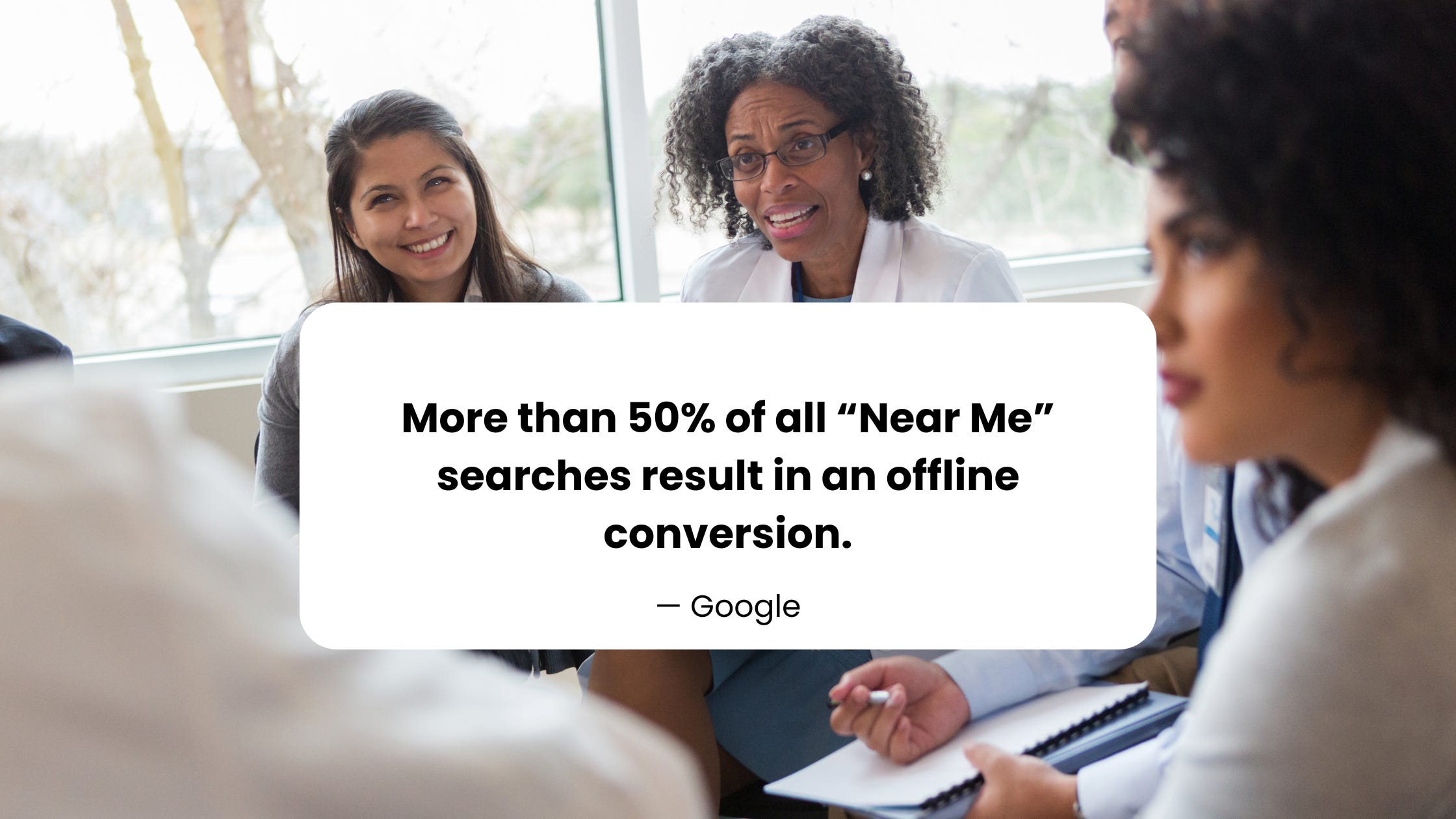
72% of users who did a Google search visited a business within 8km of where they were searching
Here’s what you need to build a predictable patient acquisition system:
Keyword research that informs your entire strategy
Local SEO that builds long-term authority
Local Service Ads that give you instant credibility and trust
Google Ads that let you scale patient volume on demand
Let’s dive in.
Traffic = Water
Before we get into the specifics, let me share something my mentor Russ taught me early in my marketing career—an analogy that changed how I think about patient acquisition:
Traffic is like water. It’s essential for growth.
Organic traffic = Rain 💧 Free, but unpredictable. Sometimes there's a drought, other times a flood. Great when it comes, but you can't control it.
Paid traffic = Garden Hose 🚿 Consistent and controllable. Turn the tap, adjust the flow. You know exactly what you're getting, but your water bill reflects every drop.
Successful clinics don’t just wait for rain—they have a garden hose ready for when the clouds don’t cooperate.
I’ve spent the last year helping healthcare practices build this Google marketing system. The ones that win? They invest in both so they’re never scrambling for patients.
Today I’m giving you the same framework I use with my clients—the exact steps to build a patient acquisition system that fills your clinic whether it’s “raining” or not.
Here’s what you need:
Keyword Research (The Foundation for… Everything)
This is where literally, everything starts. And it’s where most healthcare practices get it wrong.
Here’s why it matters:
It tells you exactly what patients are searching for, how often they’re searching, and how much competition you’re facing.
Without this, you’re guessing. With it, you’re building on data.
The good news?
Healthcare keyword research is simple. You’re targeting local patients searching for specific services.
Your keywords follow this pattern: [Service] + [Your City]
Examples:
“Botox Denver”
“stem cell therapy Austin”
“dental implants Nashville”
Someone typing that into Google already knows what they want—they just don’t know where to get it. That’s HIGH buying intent.
This keyword list becomes your roadmap. It informs which service pages to create (organic), which Local Service Ads to run (paid), and which Google Ads campaigns to build (paid).
Everything else builds on this foundation.
Local SEO (The Map Pack)
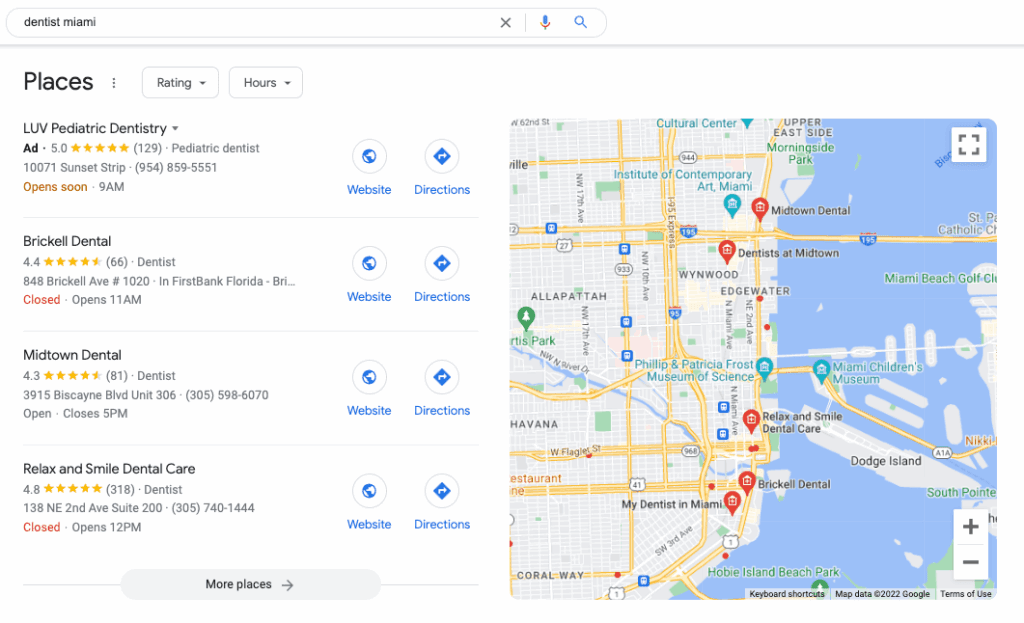
This is the “rain” from our water analogy—free traffic that works around the clock once it starts flowing.
Local SEO means optimizing your Google Business Profile and website so you show up in the top 3 local results (the “Map Pack”) when someone searches for your services.
Here’s why it matters:
The top 3 spots in the Map Pack get 75% of all clicks and phone calls. If you’re not there, you’re invisible.
Unlike paid ads, you’re not paying per click. Once you rank, that traffic is free. It works while you sleep, on weekends, on holidays—24/7.
And it builds compounding authority. The longer you rank, the harder it becomes for competitors to knock you out.
Local SEO includes three core elements:
Google Business Profile optimization - Your listing with reviews, photos, posts, and service details
Service pages on your website - Individual pages optimized for each keyword from your research
Local citations and links - Getting your practice listed accurately across the web
This is your long-term foundation. It takes 90-120 days to see results, but once you’re ranking, you have steady patient flow without ongoing ad costs.
The best part?
Local SEO makes your paid ads more effective. When someone clicks your ad and sees you also rank organically, it builds instant credibility.
Local Service Ads (LSAs)
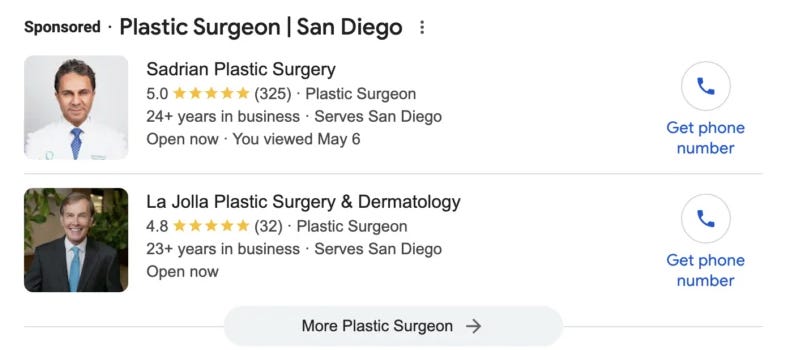
Full transparency: Local Service Ads aren't available to every healthcare practice.
Google only allows specific healthcare categories. Many cash-pay practices—like med spas, stem cell clinics, ketamine clinics, TRT clinics, and hair restoration—aren't eligible.
But there's a workaround: having a licensed dermatologist or plastic surgeon on staff lets you advertise under their categories.
If you ARE eligible, LSAs are powerful.
They’re “Google Verified” ads that appear at the very top of search results—above everything else.
They come with a Google badge that builds instant trust, and you only pay when someone calls you directly (not per click).
Healthcare categories eligible for LSAs in the US:
Acupuncturist
Allergist
Chiropractor
Dentist / Orthodontist
Dermatologist
Dietitian
Ophthalmologist / Optometrist
Physical therapist
Plastic Surgeon
Podiatrist
Primary care physician
Veterinarian
Weight loss service
Why they matter (if you qualify):
You get immediate patient flow while your organic SEO builds. You can turn them on during slow periods to fill gaps in your schedule. And combined with organic rankings, they create a 1-2 punch of credibility—patients see you’re Google-verified AND ranking organically.
Think of LSAs as your controllable faucet for practices that qualify. Not everyone can use them, but if you can, they’re worth testing.
Google (Search )Ads
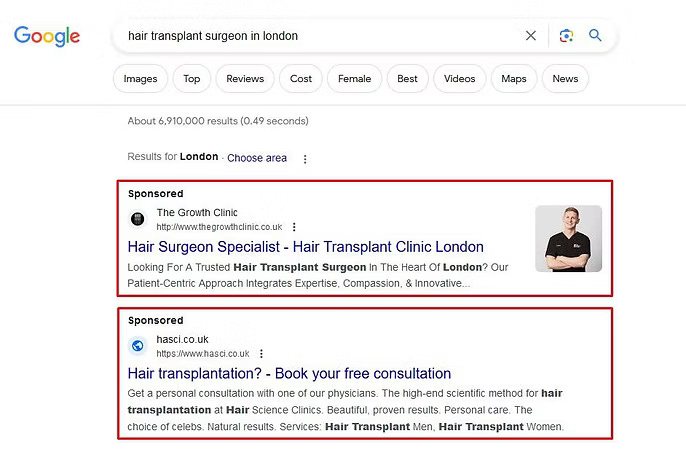
This is your ultimate control lever—the garden hose you can turn up or down whenever you need more patients.
Google Ads are the traditional pay-per-click text ads that appear below Local Service Ads and above the Map Pack.
You bid on the keywords you discovered in Step 1, and you only pay when someone clicks through to your website.
Why they matter:
They give you complete control over patient volume. Need to fill more slots next month? Increase your budget. Booked solid? Turn them off.
And unlike Local Service Ads (which not everyone qualifies for), any healthcare practice can run Google Ads.
Here’s the catch: They’re the most complicated.
There are a lot of cogs in this machine. To make Google Ads profitable, you need:
A Front-End Offer: Free consultation, first-time visitor special, something that lowers the barrier to book.
An Optimized Landing Page: Directing traffic to your homepage is the biggest mistake I see. You want to use a dedicated landing page related to the keyword you’re targeting. And there should only be one Call to Action (CTA) on the page. Your phone number. That’s it. There’s nothing else for them to click.
Call tracking: What gets measured gets managed. And without this, you won’t know what’s working, and what isn’t. You’re burning money.
I like Google Ads best when your organic foundation is already in place. Because when someone clicks your ad and sees you also rank organically, it builds credibility. They’re more likely to book.
But sometimes clinics don’t have enough reviews to rank organically.
So running ads can be a powerful jumpstart to your marketing because it gives you an immediate return and starts generating reviews that help you rank in the Map Pack.
The Bottom Line
You don’t have to choose between organic and paid marketing.
The clinics that dominate their local market do both—strategically.
They start with keyword research that tells them exactly what patients are searching for. They build their organic foundation (Local SEO) so they’re generating free traffic 24/7. They layer in paid traffic (LSAs and Google Ads) to fill gaps and scale on demand.
And that’s how you can build a system where your phone rings consistently.
Talk soon,
Nicholas
P.S. - Not sure where to start?
Reply to this email with your website URL and I'll take a look at your current setup. I'll send you one concrete action you can take this week to start attracting more local patients—no charge, no strings attached.