

The most valuable shift in my business happened in the winter of 2024 when I finally understood the 30,000 foot view of marketing.
Today I’m going to break down the Healthcare Marketing Funnel. What it is and how you can use it to grow your clinic.
I speak with healthcare business owners all the time who have been burned by marketing agencies before.
They’ve spent money on Instagram ads, paid for SEO, only to see zero return on their investment.
This will help you make better decisions in the future and know when to call bullshit on something someone is offering you.
Most people fail to successfully grow their healthcare business because they don’t understand the job each piece of marketing is designed to do. Where it fits in the grand scheme of things.
So they jump from one trend to the next, never honing in on what would really move the needle for their business.
Stop Thinking About Marketing Like A Funnel—It’s a Journey That Needs to be Mapped Out
From here on out, I’m going to refer to the Marketing Funnel as the Buyer’s Journey.
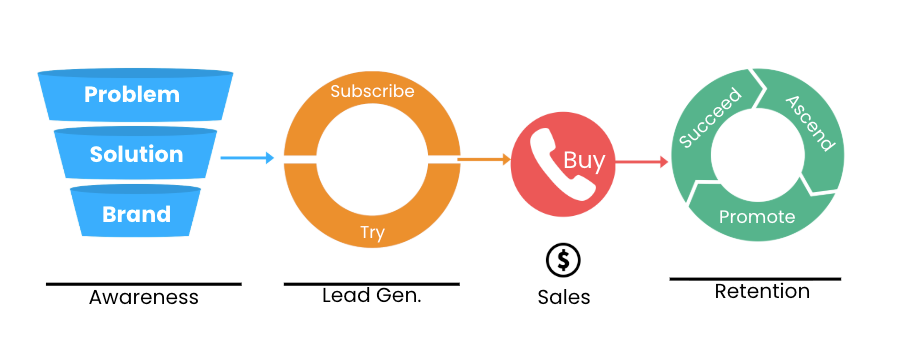
There are only 4 stages to the buyer’s journey. Seriously, that’s it.
Here’s the breakdown:

Awareness
Leads
Sales
Retention
And as my friend Russ Henneberry likes to say:
“Your marketing’s job is to move the baton from one stage to another.”
So here’s a more granular look at each stage of the buyer’s journey (funnel) mapped out:
Let’s dive in.
Awareness: Increase the Number of People Who Know About Your Business
Awareness is only the first part of the buyer’s journey.
It’s also where most people get stuck.
When it comes to generating awareness, you only have 2 options:
Paid
Organic (free)
Paid traffic grows your awareness faster, but the downside is you have to constantly pay for it. Organic is free, but it takes longer to see results. Both have their pros and cons.
These are some of the common methods you can use to generate traffic (awareness) to your business:
Instagram
Facebook
Pinterest
TikTok
YouTube
SEO
LinkedIn
… And they all target the awareness stage of the buyer’s journey.
Contrary to popular belief… you only need ONE channel to work.
You don’t need to be everywhere. At least not in the beginning.
And since healthcare is inherently local—patients need to physically visit your clinic, office, or facility—Local SEO is the most powerful channel you can leverage to get more patients in the door.
That’s because when someone searches for “emergency vet near me”, they’re not browsing, they’re ready to book. So you get the attention of a high quality lead…
3 Types of Traffic That Grow Your Clinic
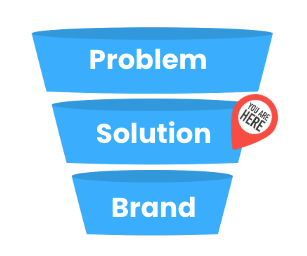
Only ONE brings in new patients ready to book. Here’s the breakdown👇
Problem Aware: They know the problem, not the solution
Traffic Quality = LOW
Buying intent = LOW (Not ready to book)
Source: Instagram, TikTok, Facebook
Solution Aware: They know WHAT they want, just don’t know WHERE to get it
Traffic Quality = HIGH
Buying intent= HIGH (Ready to book today)
Source: Local SEO (”near me” searches)
Brand Aware: They know who you are, your clinic, doctors, services…
Traffic Quality = HIGHEST
Buying Intent = HIGHEST
Source: Referrals/returning patients
(Brand aware traffic generally reflects the strength of all your marketing efforts.)
If you want NEW patients in the door each month, your marketing needs to attract high quality traffic.
Local SEO targets Solution Aware patients—people actively searching for what you offer with high buying intent.
One More thing…
It’s worth mentioning that e-commerce brands, tech companies, and the rise of creators selling digital products, CAN’T use this channel.
Local SEO works to attract people in your city—vital for growing your practice—but not so much for the software company selling a project management system.
So instead of competing nationally for social media attention, you focus on dominating the local searches happening in your backyard by people ready to become patients.
But convincing you about the effectiveness of local SEO isn’t the point of today’s lesson.
The point is that you need ONE channel to generate consistent awareness (traffic) for your business and your services.
Once you have the right people’s awareness, you want to move them to the next stage of the buyer’s journey.
Leads: The Money is in the List
Picture your clinic as a booth giving away free samples in a grocery store.

The awareness stage meant letting everyone in the store know about your booth.
But the lead generation stage, means giving away free samples in exchange for someone’s contact information.
(Specifically their name and email address. Sometimes their phone number.)
That’s because anyone who comes to your booth and takes a free sample, has raised their hand. They’ve expressed interest in what you offer.
They might not buy yet, but you definitely want to talk more with them. To stay on their radar.
When it comes to healthcare, the free sample (also called a lead magnet in marketing circles) varies by industry.
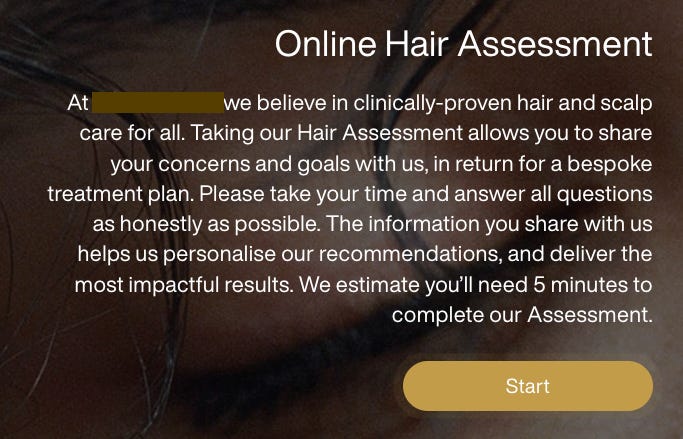
For example, if you own a hair transplant clinic, a really good way to get someone’s name and email is to offer a free hair assessment quiz.
Like this:
But if you own a med spa, a simple 10% discount, or a free consultation is enough to get someone’s contact information.
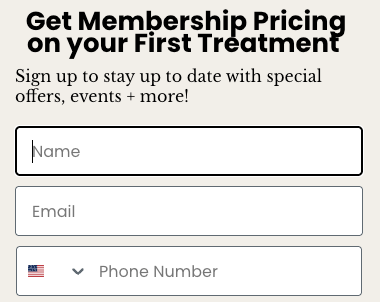
The free sample needs to be something easy and low-risk so giving up their email is a no-brainer.
The idea is that your marketing has worked hard to get them to your website. But we know that not everyone books or calls on the first visit.
So by collecting their email address, it allows you to follow up with them and stay top of mind.
Which takes us to the best marketing channel best for lead generation:
Email marketing
Whenever you read content, or someone tells you how they grew their business with emails that generated XX amount, they took leads and converted them into sales.
But be warned, if you do not have a lot of awareness (traffic) coming to your site, email marketing won’t help you. Because you don’t have enough people to transform into leads.
Once you have leads, you’ll want to move them to the third stage of the buyer’s journey.
Sales: Getting Patients in the Door
How fast you turn a lead into a sale depends on your industry.
Selling hair implants or a nose job, is a longer sales cycle. It requires more time nurturing the lead with email marketing.
Selling hydrafacials, massages, or teeth whitening is going to be a shorter sales cycle.
But one thing stays the same across the healthcare industry.
The sale happens with a phone call.
That’s where:
The appointment gets booked
The consultation gets scheduled
The patient commits
Not to beat a dead horse, but it’s yet another reason why Local SEO is so powerful…
Patients will often call, right on the spot, when they find your business on Google. Thereby leap-frogging the whole lead generation stage and going straight to the sales stage.
That’s a lot less likely with social media. (When’s the last time you called an account you followed on Instagram?)
But let’s get back to the topic at hand.
Sales.
And for healthcare, that means phone calls.
So it’s important to always have someone, like a receptionist, to answer the phone, and get them to book an appointment.
Retention: Your Best Buyers are Your Buyers
If someone gets amazing results from your stem cell treatment or loves their Botox results, they’ll tell their friends. They’ll leave you a 5-star Google review (which boosts your local SEO rankings). And they’ll come back for more.
But most clinic owners are so focused on getting NEW patients, they forget about the gold mine sitting in their patient database.
The retention tactics that work for healthcare:
Email sequences for repeat treatments: If someone gets Botox, send them a reminder 3 months later when it’s time for a touch-up
Referral programs: Offer existing patients $50 off their next treatment for every friend they refer
Google review requests: After a successful treatment, ask for a review (these feed back into your local SEO)
Membership programs: Monthly or quarterly packages that keep patients coming back
The math is simple:
A patient who visits once might be worth $500. A patient who visits 4x per year for 3 years is worth $6,000.
The Bottom Line
Ryan Diess, founder of Digital Marketer once said:
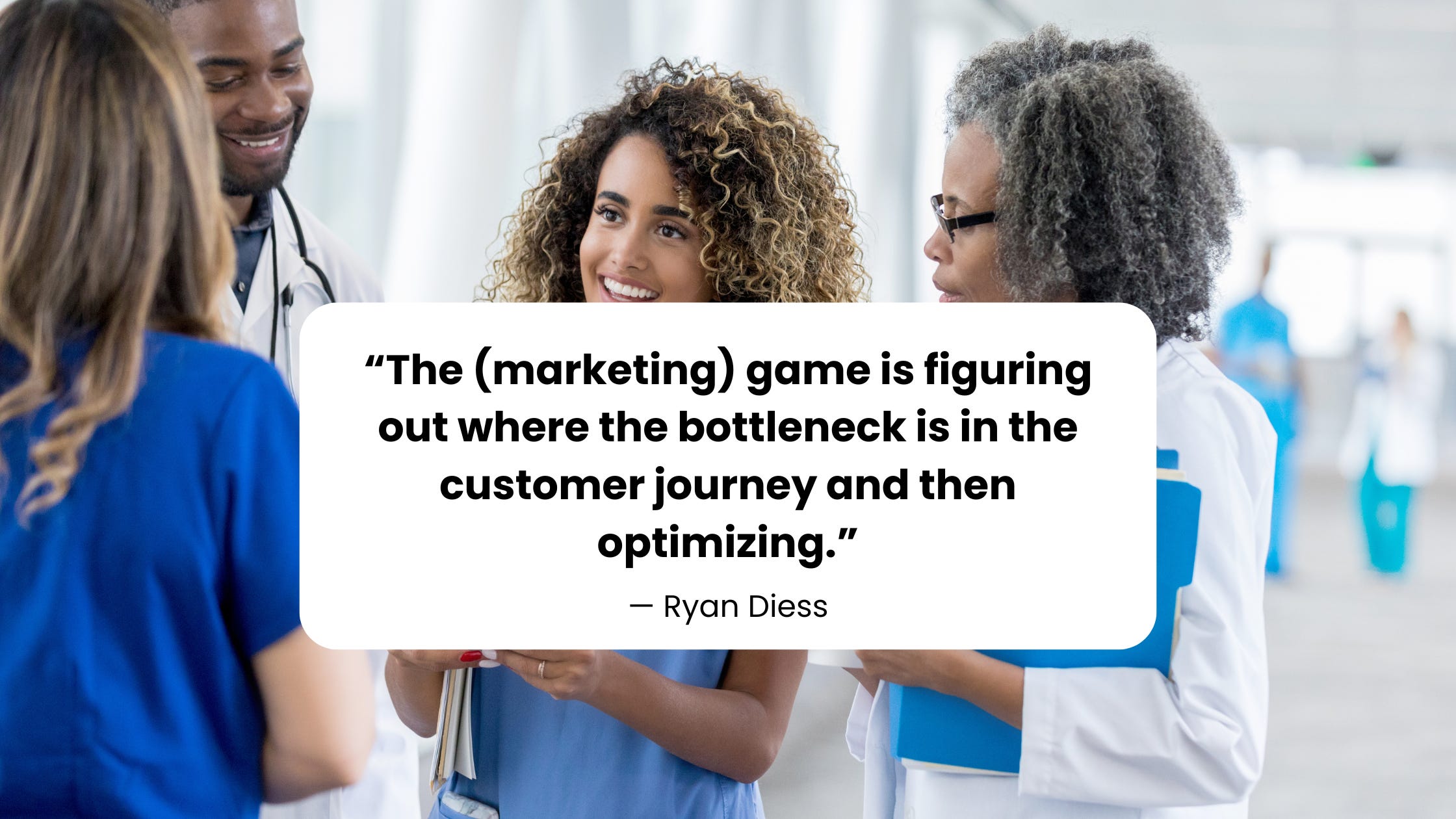
“The (marketing) game is figuring out where the bottleneck is in the customer journey and then optimizing.”
I think that sums up what we’ve learned today nicely.
Instead of jumping from tactic to tactic—Instagram one month, Facebook ads the next—use this framework to think through marketing your healthcare business:
Visualize the patient journey (literally, map it out)
Measure conversions at each stage
Find the bottleneck
Optimize
A Quick Thought Experiment to Find YOUR Bottleneck
Let’s say you run a TRT clinic. Ask yourself these questions:
Question 1: Are you getting enough people to your website or calling your clinic?
If NO → Your bottleneck is Awareness. You need more traffic.
If YES → Move to Question 2.
Question 2: Are website visitors giving you their email or calling to inquire?
If NO → Your bottleneck is Leads. You need a better lead magnet or clearer call-to-action.
If YES → Move to Question 3.
Question 3: Are those leads actually booking appointments?
If NO → Your bottleneck is Sales. You need better phone follow-up or nurture sequences.
If YES → Move to Question 4.
Question 4: Are patients coming back for follow-ups or referring friends?
If NO → Your bottleneck is Retention. You’re leaving money on the table.
If YES → Congratulations. Now scale what’s working.
Most healthcare practices I talk to have an awareness problem—they’re invisible in their local community.
But until you honestly assess where YOUR bottleneck is, you’ll keep spinning your wheels on tactics that don’t move the needle.
My hope for you is that you can finally stop feeling overwhelmed by marketing.
That you can identify your bottleneck, fix it, and get back to what you do best—helping patients transform their health.
Talk soon, Nicholas
P.S. - Not sure where your bottleneck is?
Reply to this email with your website URL and I’ll personally take a look at your website and marketing. I’ll send you one actionable improvement you can take this week to start attracting more local patients.