

Last month, while I was in Seoul, South Korea, I indulged in some medical tourism.
Just some RF microneedling to treat acne scars I've had since my early 20s—and a Botox trial run at my girlfriend's suggestion.
Since medical tourism is a competitor to a lot of clinic’s in Canada and the U.S., I thought I’d share my experience and thoughts on the matter as someone who is both a consumer and a marketer.
Let’s dive in.
Medical Tourism: Beauty, Youth, and Sex Appeal At a Fraction of the Cost
Whether we’re talking about getting that perfect straight white smile (dental work), flaunting a full head of luscious hair (hair transplants), fixing that crooked nose you’ve always disliked (plastic surgery), or having beautiful skin and turning back the clock (skincare and med spas)...
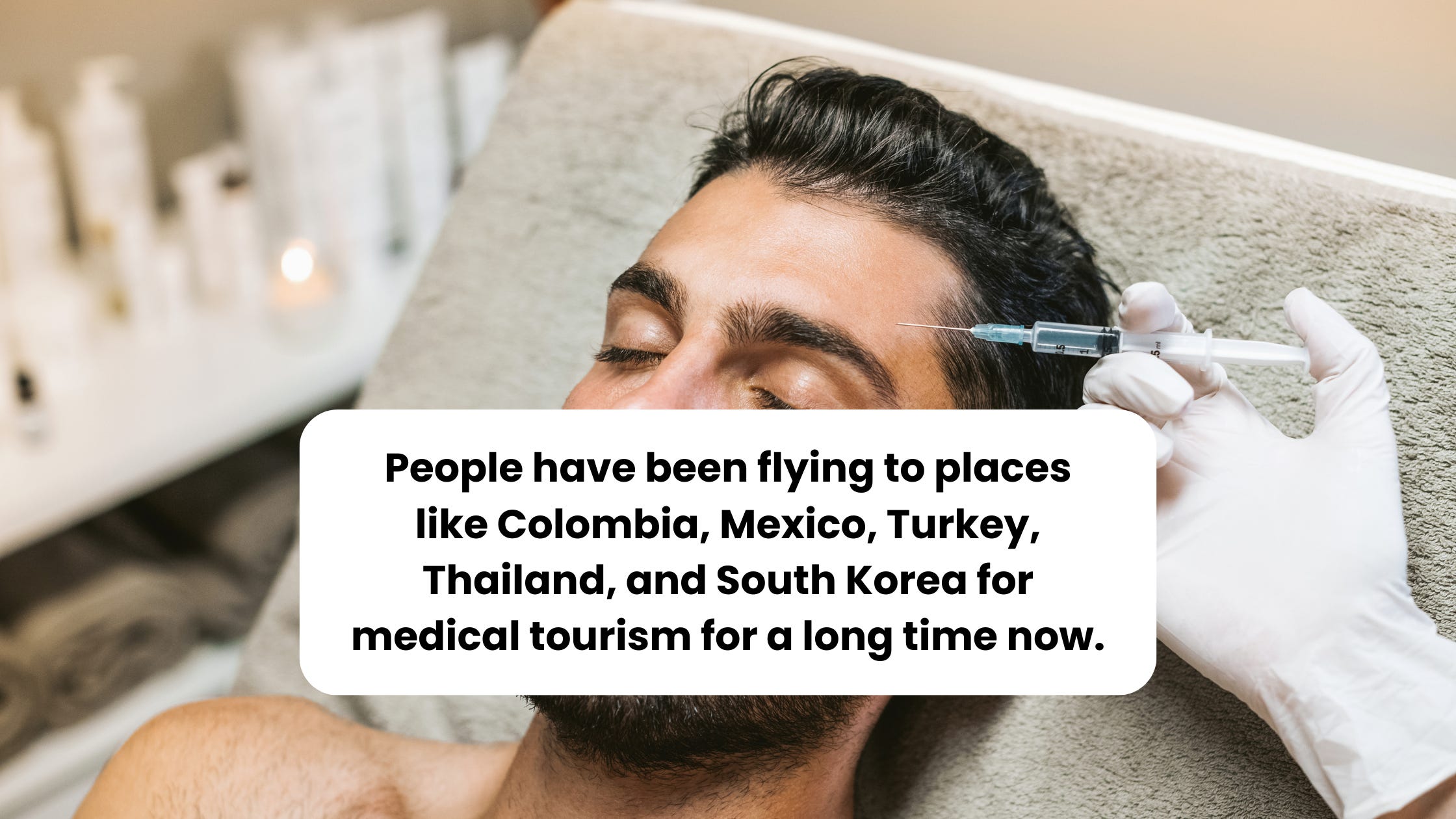
People have been flying to places like Colombia, Mexico, Turkey, Thailand, and South Korea to get these things done for a long time now.
You see it on social media.
You hear it from a friend who had work done.
We’re all aware of it as an option.
And many clinic owners fear losing business to these over seas competitors.
But should they?
Do you have anything to fear?
Do you need to tell your patients to stay away?
I would argue that you don’t.
Let me explain…
The Real Advantage: Follow-Up Care and Trust
One of the biggest drawbacks of medical tourism is what happens after.
You can’t just walk back into the clinic 3 weeks later for a touch-up. The language barrier becomes a problem again if something goes wrong.
That’s your unfair advantage as a local clinic.
You can see patients again. Adjust treatments. Build long-term relationships. That’s worth more than saving a few hundred dollars.
This is something medical tourism simply can’t compete with.
It’s Not All Sunshine And Rainbows on The Other Side
I went to Asia as I usually do around this time of year.
The only difference is that this year we stopped in Seoul to get some work done.
But as anyone who’s travelled before will tell you, it inherently has its challenges.
One of the biggest challenges is the language barrier.
The language barrier is real.
We needed a translator at the clinic. And from the moment you land—navigating transit, ordering food, even reading reviews—everything’s harder.
Koreans also use Naver instead of Google Maps. Which means building trust with a clinic when you can’t easily research them is a challenge.
While a lot of these places do speak English, it’s not their first language.
Let’s Talk $$$ For a Moment
Yes.
It’s cheaper.
It’s like drinking wine in Italy. You get so many quality wines for A LOT less.
And yes, you’ll probably bring a couple of bottles back with you.
But does that mean you wouldn’t stock up at your local store, and only buy wine in Italy?
Of course not.
The cost of the plane ticket, hotel stay, food, and entertainment stack up. And if you factor those into the equation, you’re still spending a lot of money.
Personally, I was able to get:
RF microneedling with
Potenza
Juvelook
Botox
For $500 CAD.
That’s really nothing.
I could easily pay $1000 CAD for Botox alone here in Montreal.
But if you factor in all the other expenses of the trip, the costs add up.
So yes.
If you’re already in the area, medical tourism can save you money.
But if you travel exclusively to save money, I don’t think you’d really be saving all that much.
The Bottom Line
My Seoul experience was great—good service, great price, and I was already traveling.
But here’s the truth:
Most people would rather work with a local clinic they trust than fly halfway across the world for a procedure.
The patients choosing medical tourism probably aren’t your ideal clients anyway. They’re price-shopping, not relationship-building.
Your job?
Attract patients who value trust, proximity, and ongoing care over rock-bottom prices.
Don’t compete on cost. Compete on quality and relationship.
Think Rolex: Quality. Craftsmanship. Status. Trust.
Be the Rolex of clinics in your area—the one patients return to because they know you’ll take care of them.
Medical tourism will always exist. But it will never replace the value of a trusted local provider.
So, remember:
You don’t have anything to worry about if you follow the principles I share in this newsletter to grow your clinic.
That’s all for today.
Talk soon,
Nicholas
P.S. - Want to grow your local clinic? Reply to this email with your website URL and I’ll send you one concrete improvement you can make this week to start attracting more local patients—no charge, no strings attached.