

Spend any amount of time on the internet and you’ll come across lots of different— often conflicting—advice about how to market your med spa.
Some people swear by Instagram, others say it’s dead. Referral programs, Facebook, Google ads, SEO, AI... everyone has a different answer.
For those of you actually running a MedSpa, today I’ll break down what works vs. what’s a waste of time and money.
This is insight based on dozens of conversations with clinic owners, and from the results my agency has achieved working with med spas.
Let’s get started.
Two Ways to Sort Every Marketing Method
Before I rank anything, it helps to know what you’re actually comparing.
Every method falls into two categories:
Organic vs. Paid.
Organic is free but costs your time. Paid is fast but costs you budget—and disappears the moment you stop paying.
On-Demand vs. Interruption.
On-demand marketing shows up when someone’s already searching for what you offer. They have a problem, they know the solution, they’re looking for who to buy from. This traffic already has buying intent.
Interruption marketing shows up while someone’s scrolling, doing literally anything else. You’re asking them to stop and pay attention to something they weren’t looking for. Interruption traffic doesn’t having buying intent.
Keep both of those in mind as we go through the marketing methods.
Marketing Methods Ranked
1. SEO (Search Engine Optimization) + AI Search
This is on-demand and (mostly) organic.
Someone types “Botox near me” on Google or asks ChatGPT/Claude/Gemini where to get lip filler in their city, and you either show up or you don’t.
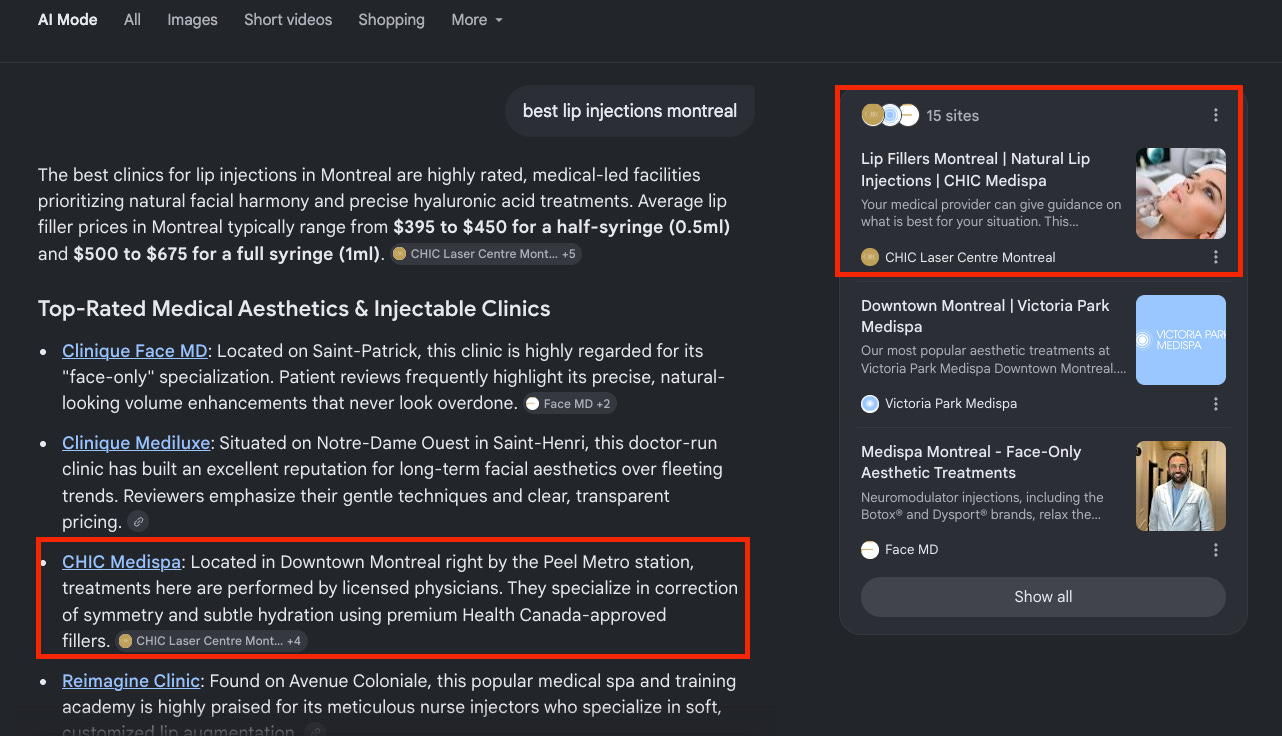
The patients who find you this way already want what you offer.
They’re not being sold, they’re doing research.
And, that’s the whole game.
This type of marketing compounds. The work you do now still works for years to come. In fact the sooner you dominate search results the harder it becomes for your competitors to outrank you.
(It’s why med spa’s with good SEO tend to sell for more, because buyers know they’ll continue generating bookings for years to come.)
Compare that to an ad campaign, where the leads stop the second you stop paying.
You’re not renting visibility. You’re owning it.
Pros:
Compounds over time
Search traffic from Google & AI has the highest conversion rate
Works 24/7 in the background
Builds trust with your med spa
Cons:
Takes 3-6 months to see consistent bookings
Requires patience during the ramp-up period
Harder to “turn on” instantly when you need patients next week
2. Google Ads
As a general rule of thumb, SEO can take 3-6 months for your med spa to start ranking and generate consistent bookings.
Since Google ads is still on-demand marketing (same search intent as SEO), we sometimes run a paid ad campaign in those early months to start getting bookings immediately.
The only difference is you’re buying your way to the top instead of earning it.
It’s faster than SEO, which is the appeal.
It also makes it the first thing that goes quiet the moment cash flow gets tight, which is the tradeoff.
It’s a good bridge while your SEO builds. Expensive as a permanent foundation.
Here’s what we usually expect to spend to acquire CoolSculpting patients:
Min monthly ad Budget = $2,000 - $2,500
Cost per lead = $75 - $125
Estimated number of leads for ad spend = 16-33
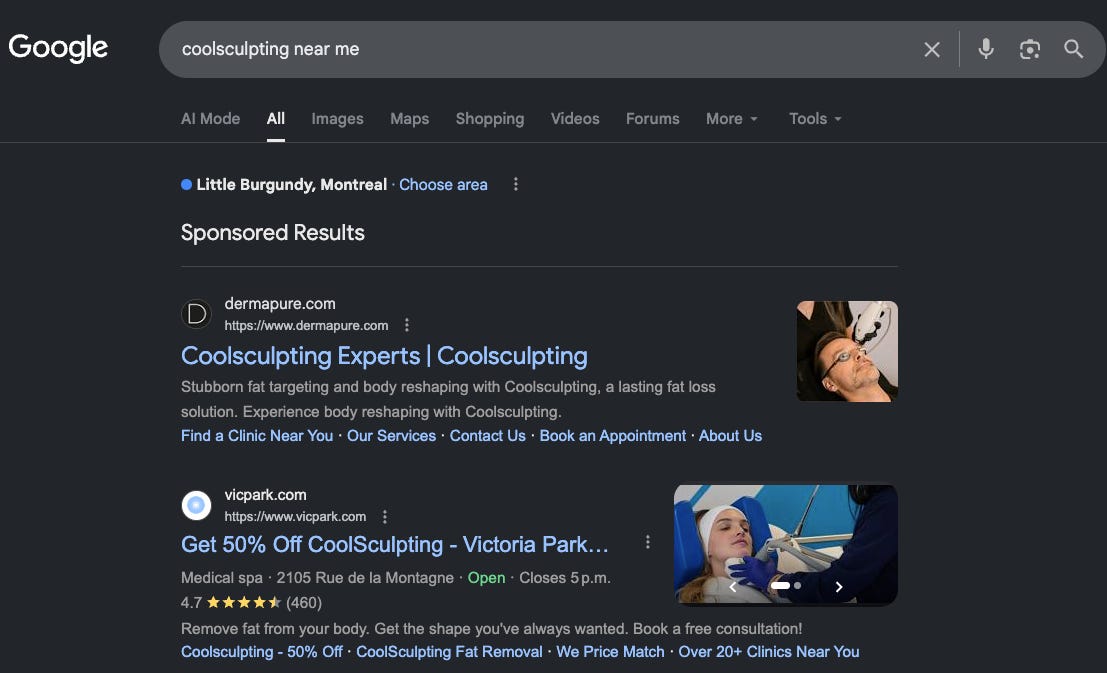
Here are the pros and cons summed up in a nutshell:
Pros:
On-demand—same buying intent as SEO
Fast—can generate bookings within first week
Good bridge while SEO builds
Budget is controllable and adjustable in real time
Cons:
Leads stop the moment you stop paying
Cost per lead can climb in competitive markets
Doesn’t build any long-term asset—you’re renting, not owning
3. Facebook (+ Instagram) Ads
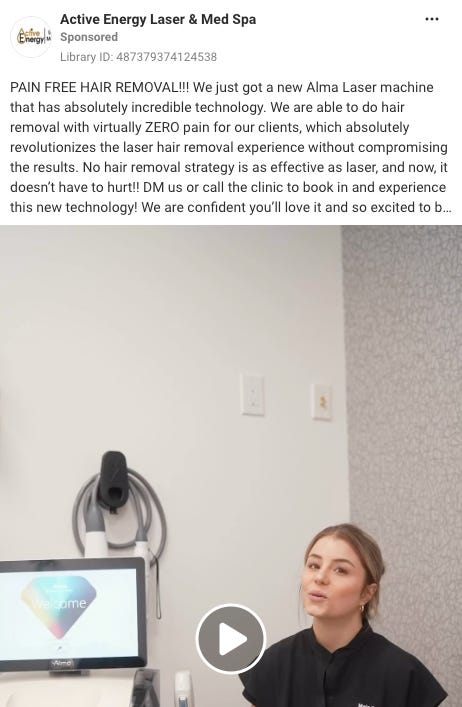
This is paid + interruption marketing.
You’re not catching someone who definitively wants Botox—you’re targeting someone who might have an interest in it, but was looking at vacation photos and now sees your ad.
This is usually where the “price shopper” problem starts if you don’t have a proven funnel set up.
Oh, and FYI, you’re not going to sell a $3000 CoolSclupting package right out of the gate with these ads.
Usually, you lead with a cheap, front-end offer designed to get people’s contact information so you can market to them down the line.
This tends to come in the form of discounted treatments. The money is made with upsells from consultations and email marketing.
Getting them to come back and buy more expensive treatments now that they know, like, and trust you.
Pros:
Fast results—can generate leads within days
Budget is controllable and adjustable in real time
Can work well with a proven front-end offer + upsell funnel
Good for retargeting people who already know your brand
Cons:
Leads stop the moment you stop paying
Interruption-based—low buying
Competing against the entire internet, not just local competitors
Tends to attract price shoppers if the funnel isn’t dialed in
Requires high marketing IQ to be profitable
4. Organic Facebook & Instagram Content
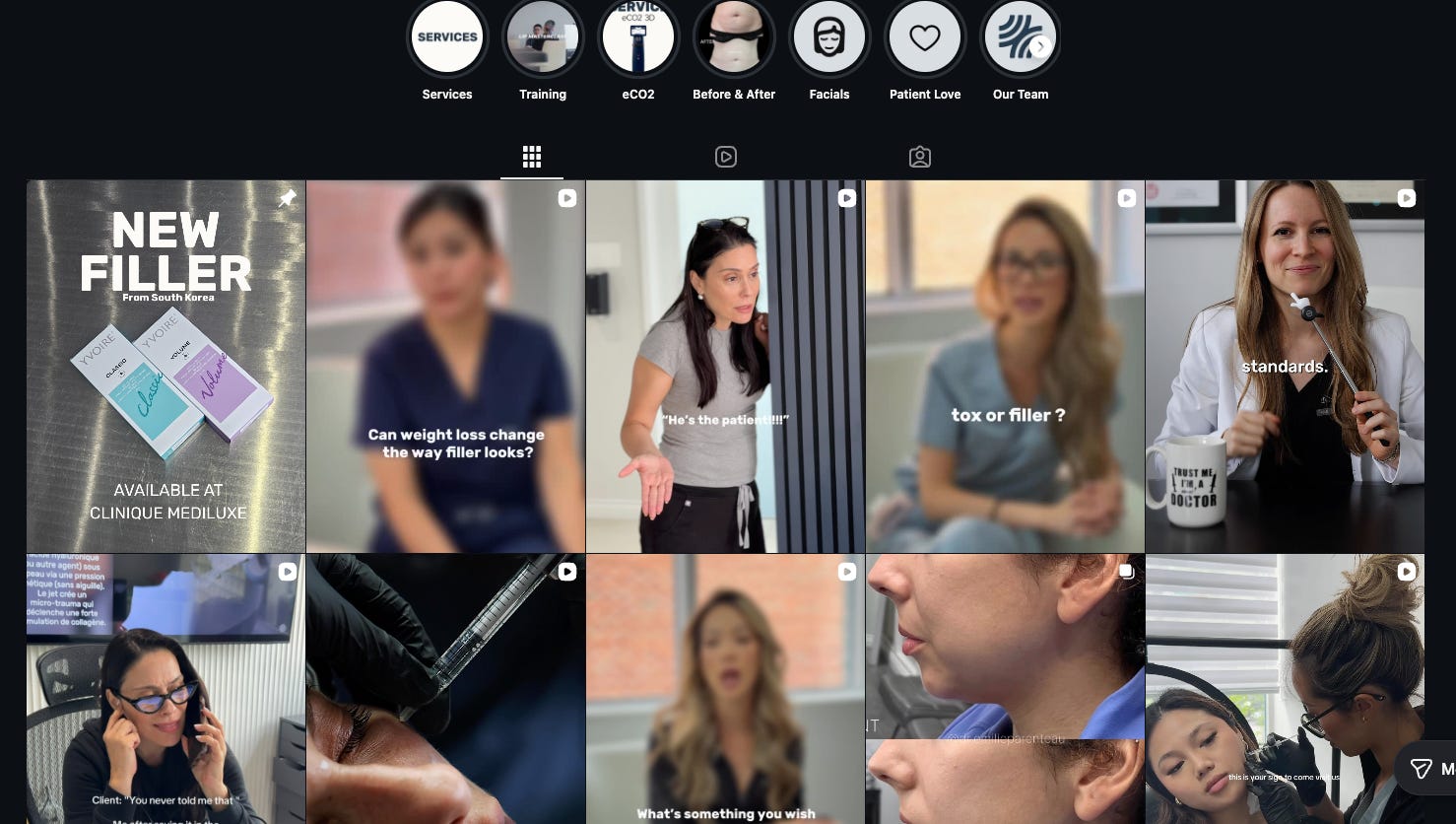
This is where most med spas start—and get stuck.
It’s free, so it’s got a low barrier to entry.
Which sounds awesome until you actually do it.
You’re spending real hours creating reels and posts, competing against an algorithm that’s actively deciding whether to show your content to anyone at all, to reach people who weren’t looking for a med spa in the first place.
So it’s also interruption marketing.
There’s low buying intent from the majority of people.
It’s not that social media does nothing.
In fact, we use social media more like social proof—since patients will often check out your socials… after they find you on Google.
It can move someone from the consideration phase to actually booking, so it’s worth having a social media presence for that reason alone.
But if it’s your primary strategy for filling your schedule, it’s the most labor-intensive, least predictable option on this list—and it’s usually the first thing owners burn out on.
Pros:
Free to start
Builds social proof once patients find you elsewhere
Can move someone from considering to booking
Useful for showcasing team, culture, and results
Cons:
Low buying intent—most viewers weren’t looking for a med spa
Algorithm-dependent—no guarantee of reach
Time-intensive with no direct line to revenue
Easiest channel to burn out on for the least predictable return
The Bottom Line
If expensive treatment devices sit unused, payroll obligations remain unchanged, and every new month begins with the pressure of generating enough demand to cover overhead.
I would deploy a combination of SEO and Google ads.
SEO is the long term patient acquisition strategy, while Google ads can get you booking this month.
The med spas that are winning right now aren't the ones chasing every new platform or tactic.
They're the ones that picked the channel with the most staying power, put in the work early, and let it compound while everyone else starts over every few months.
That’s all for today.
Take care,
Nicholas
Never Worry About Empty Treatment Rooms Again.
When you dominate local search, you effectively build a system that attracts high-value patients consistently. (Think Botox, PRP, peptides, CoolSculpting, etc… and not price shoppers.)
It’s like setting up an insurance policy that secures your clinic’s growth in the long run because you’ll be visible to patients who are actively looking for the services you offer.
And the longer you dominate the local search results, the more established and recognizable your med spa becomes. (I call it the compound interest of SEO effect.)
Get your Free Local SEO Report and find out exactly where you stand right now.
Here’s what you’ll see:
Where you rank compared to your top local competitors
What patients in your area are actually searching for right now
The gaps that are sending high-value patients to other clinics
Afterwards you’ll have practical, actionable insights you can act on. No commitment. No sales call. Just your data.